

There are just a few passing references to him I found on the Internet. Nothing substantial. I searched high and low. There’s not a single photograph. Nowadays, that’s almost as if you never existed. Ridiculous, isn’t it?
Dennis D’Amico.
He was an advertising art director. We both worked at the same New York ad agency, Ally & Gargano, for a few years in the early 1980s. After we worked on some advertising campaigns together, we became friends.
He was tall, with dark hair and a neatly-cropped moustache. He spoke with a wispy voice. He was fastidious in his dress and in everything else. His office was always immaculate, everything in its place. He worked mathematically, with precision, using his tools like an architect or master builder. He often liked to work standing up. He did not like the sprawling, the unruly, the chaotic. He loved what he did. He worked hard at it.
He liked to laugh. His laugh was the same as his talk, wispy. He found things that he thought were funny around the agency, especially people. There was plenty to laugh about at that ad agency, plenty of eccentric characters, plenty of the outlandish.
We worked on the Traveler’s Insurance account. We produced print ads and television commercials, two of which we shot in California. I liked working with him. If he thought a headline I came up with was substandard, he told me so. He was stubborn. He wouldn’t back down. That never bothered me. Well, maybe for a minute or two.
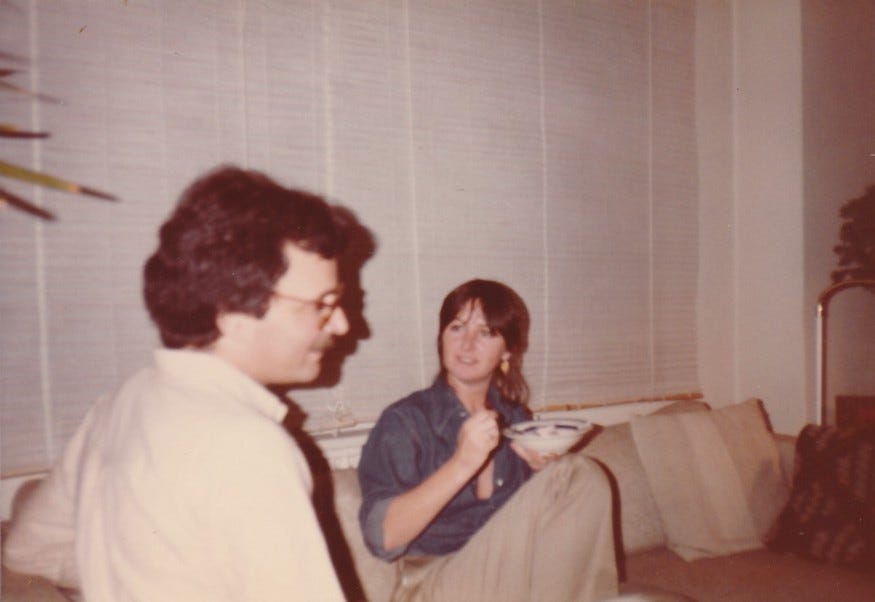
He often worked late. I remember wandering into his office at 7:00PM one evening, and there he was, only a desk light on, radio playing low. Why do I remember the song? “People Who Died” by Jim Carroll. That same evening, a brilliant, hilarious female copywriter strolled in. “I had a coffee enema today,” she announced. “I could pass the white glove test.” Dennis and I looked at each other. We had one of those silent takes you have in those kinds of speechless situations. Every once in a while, Dennis and I would look at something we did, and one of us would ask, “Can it pass the white glove test?”
He owned a house in the Berkshires with his brother. He invited me up a few times, and it was good to see him outside of work. He and his brother were always working on some part of the house. I remember going up in the fall and, once, in the winter. The Berkshires are beautiful in any season, and I was grateful he asked me to be there with him.
Dennis was the first person at the ad agency that I told about my love affair with Jerilyn, the rough-and-tumble office manager of the agency. We kept our love affair a secret, because, I think, romances between employees were not allowed. Or maybe we just wanted to keep it secret. But I told Dennis.
Then he started dating Betty—I wish I remembered her last name!—who worked as an assistant at the ad agency. Eventually, they married. They were a good match. They were happy. I was glad to see him in such a good state.
I left the agency, went to France, wrote a book. Dennis and I lost touch after a while. I came back and tried to get back in touch. I wrote him a letter or two to his Berkshires address but never heard back. Then I heard, somehow, that he was sick. He had cancer. I tried to find out if he was in a hospital and, if so, which one. No luck.
Then, sometime later, I heard he’d died. I don’t know how old he was when he died, but I can’t believe he was over 50.
One day, I ran into his wife, Betty, on the street. It had been a hard death. “It was terrible,” she said. “And he was so young!” she said. I wish I’d seen him one last time before he died.
There is one picture I have of him in my mind. I don’t know why. It’s a bit absurd, but it expresses a certain outsized relentlessness Dennis demonstrated sometimes.
It’s winter. I’m up at his house in the Berkshires. It’s snowing fiercely, and it’s very cold. Dennis insists on barbecuing outside, despite the weather. He puts on heavy clothing and takes a tray of raw steaks outside into the swirling frenzy. I can see him at the grill, turning the meat, his figure almost obscured by the snow. He keeps at it. Then, finally, he comes back in with a tray of smoking, charcoaled meat. His moustache is almost white. He’s got snow on him everywhere.
“Leopard dinner!” he says, and then gives a wispy laugh. He puts the tray down and takes off his outdoor clothes, snow falling everywhere. “Let’s eat before it gets cold,” he says, and we do.
What a wonderful portrait!
You are so good at keeping the people you cared about alive with your words. I don't know if they appreciate it, but I believe they smile somewhere when their names are mentioned and their stories are told.